

Where Your Conservation Dollar Actually Goes
The overhead myth, the funding mismatch, and the question donors never think to ask

I have spent enough time in wildlife rehabilitation to recognize a pattern most donors never see. The animals coming through intake tell a story about where conservation funding lands. Raptor poisonings spike in “protected” areas. Orphaned mammals arrive from habitat fragmentation that a land trust claimed to have addressed. Reptiles get hit on roads cutting through corridors marked “restored” on annual reports.
Press releases say the work was funded. Outcomes say something different.
You are sold a story about overhead percentages while the real question goes unasked: what happens on the ground after the donation clears?
The Overhead Myth
Charity Navigator removed the administrative expense ratio from its rating system in 2023. They acknowledged what people inside the nonprofit sector have known for years: obsession with keeping overhead low creates unsustainable organizations.
Donors did not get the memo.
Research from Florida’s “Giving in Florida” study found one of the top reasons donors stop giving is because they believe organizations are mismanaging financial resources and spending too much on administration and fundraising expenses. The irony is that financial mismanagement among Florida’s 27,000-plus nonprofits is rare. The disconnect between perception and reality is the problem. Donors evaluate organizations based on a metric that tells them almost nothing about effectiveness.
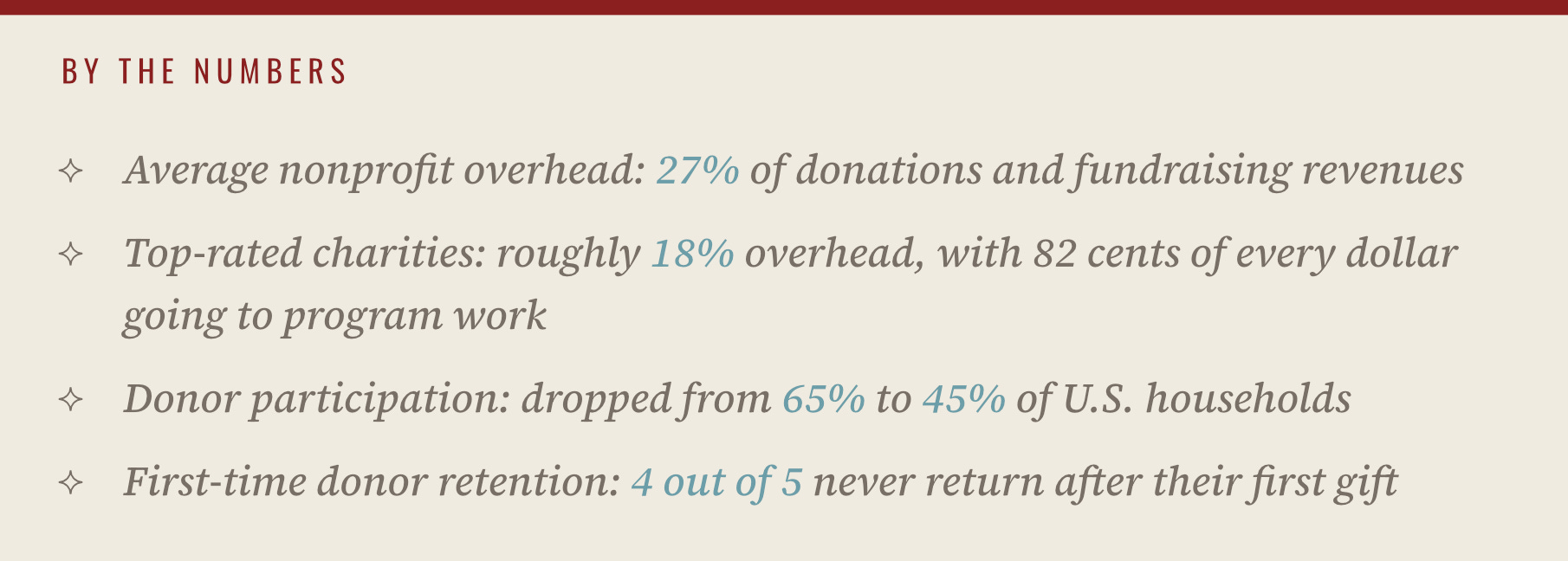
A conservation group can have beautiful overhead numbers and still protect land that degrades because nobody budgeted for invasive species management. They can have a 90% program spending ratio and still fund projects that look good in photos but fail to address the systemic threats killing wildlife.
The percentage is a distraction from the question you should be asking: what are you actually funding?
Paid subscribers receive the rest of this article early. For free subscribers, the content below will unlock in 48 hours.
THE BOTTOM LINE
Overhead percentages measure how money moves through an organization. They do not measure whether that organization accomplishes meaningful conservation outcomes.
The “100% to Programs” Gimmick
Some organizations market themselves with claims that 100% of your donation goes to programs. This is accounting theater.
Here is how it works: they ask certain donors to designate contributions specifically for administration. One foundation reportedly has parents of staff members donate to cover salaries, audits, and rent. The organization then tells everyone else their donation goes entirely to programs because someone else is covering the infrastructure.
This creates pressure on other nonprofits to artificially understate overhead or risk looking wasteful by comparison. The result is a sector full of organizations unable to invest in the systems, staff, and infrastructure that make long-term conservation work possible.
When you penalize organizations for spending money on those things, you are not funding efficiency. You are funding burnout and institutional fragility.

The Bigger Problem: Funding Mismatch
The real issue is not overhead. The real issue is that conservation dollars go to the wrong places.
Ninety-eight percent of wildlife are species that are not hunted or fished. Only about 10% of conservation spending is dedicated to those species.
State wildlife agencies prioritize game species management even when 88% of the species in their states fall outside hunting or fishing categories. The funding structure follows hunter and angler license fees. The species that generate revenue get the resources. Everything else competes for scraps.
A recent study found 94% of all funding for wildlife conservation and management comes from the non-hunting public, while hunters pay 6% of the bill. This contradicts the widely promoted narrative that hunters fund conservation, but more importantly, it reveals a structural problem: public agencies protecting public resources are not funded by public dollars in any transparent or equitable way.
WHY IT MATTERS
When you donate to a conservation organization, you are often filling a gap that should not exist. You are covering work a functioning public system would handle if wildlife policy reflected public values instead of industry lobbying.
The Global Funding Gap
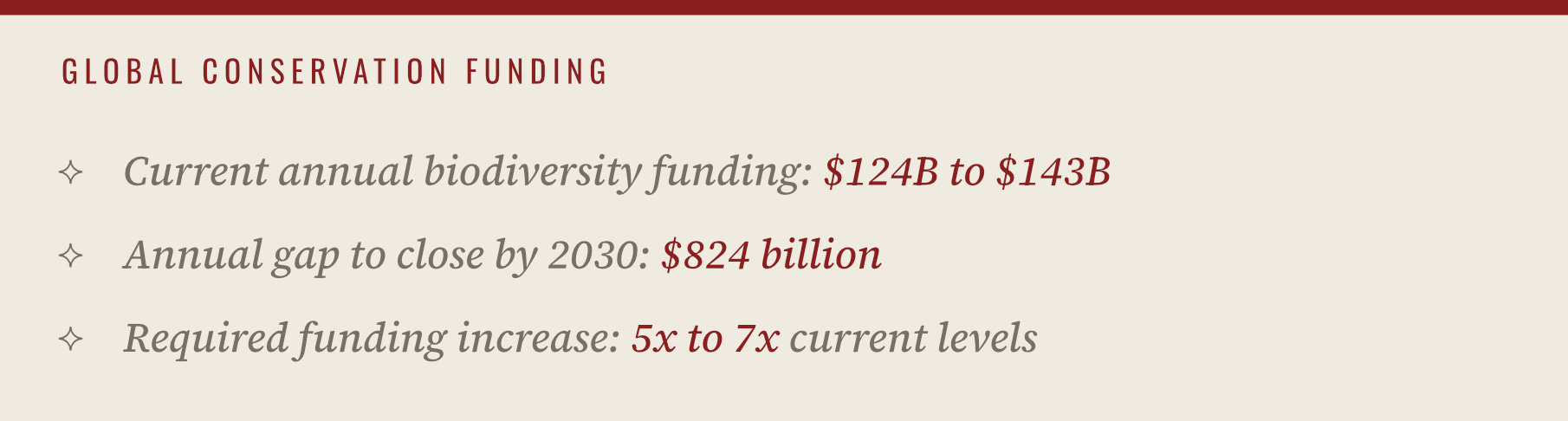
The global economy directs between $124 billion and $143 billion annually to biodiversity funding. The world needs to close an annual financing gap of as much as $824 billion by 2030.
Current conservation funding needs to increase by a factor of five to seven times to meet estimated global needs for biodiversity conservation.
You are not underfunding conservation because you are stingy. You are underfunding it because the scale of the problem is exponentially larger than the funding mechanisms designed to address it. Most organizations asking for your donation are not honest about that gap.
Even if every conservation nonprofit doubled its budget tomorrow, the funding would still fall billions short of what biodiversity protection requires globally.

What to Look for Instead
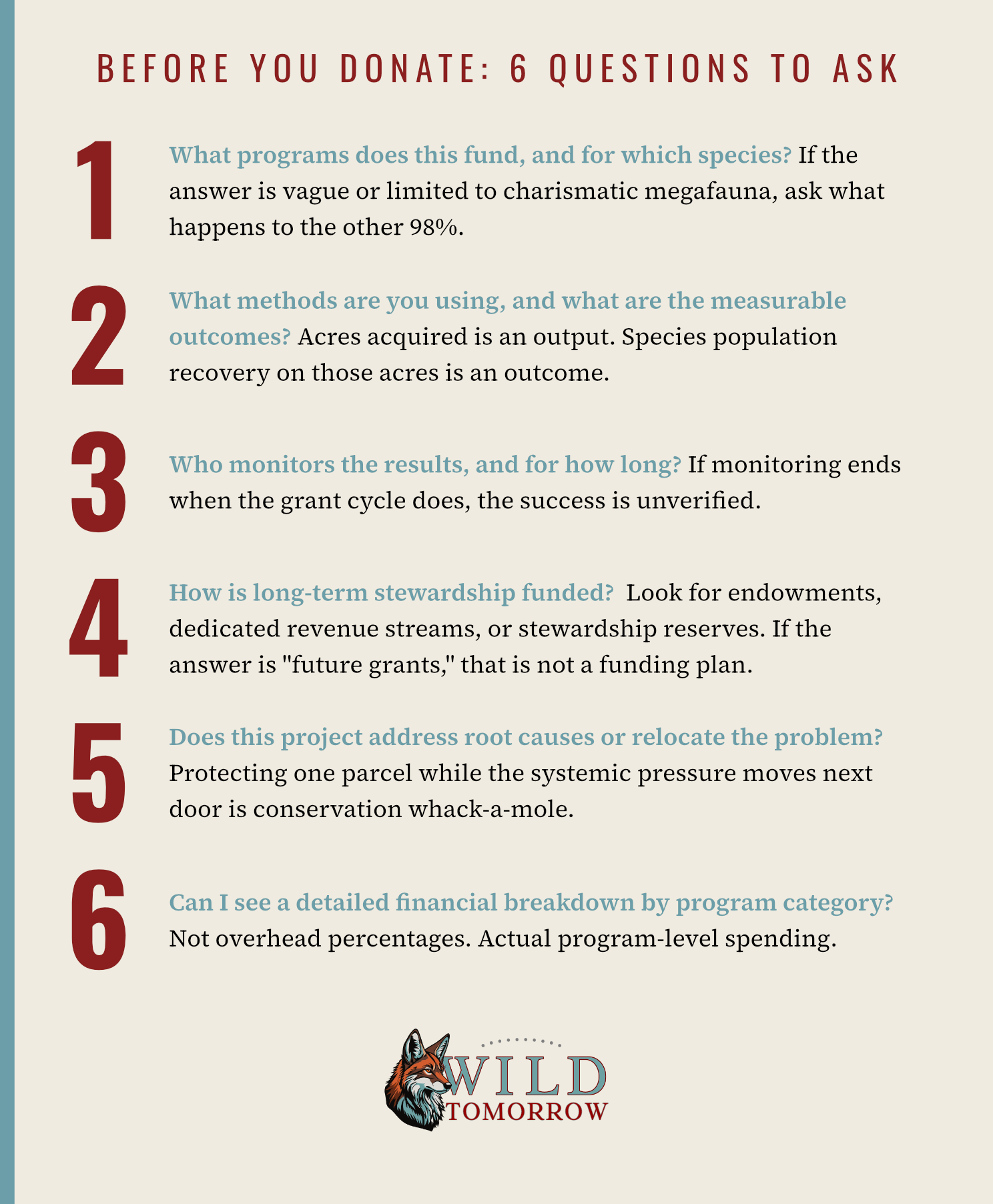
If overhead percentages do not tell you what you need to know, what does?
TRANSPARENT FINANCIALS
Does the organization publish detailed financial reports that break down program spending by category? You should be able to see where the money went, not just what percentage went to “programs.” World Wildlife Fund, for instance, reports 83% of spending on worldwide conservation activities, 10% on fundraising, and 6% on finance and administration. Those numbers are not perfect, but they are specific and publicly available.
OUTCOMES OVER OUTPUTS
Did the organization protect 5,000 acres, or did it protect 5,000 acres and then monitor whether the target species are actually using that land? Did it restore wetland habitat, or did it restore wetland habitat and track whether hydrology, plant diversity, and invertebrate communities are recovering toward a reference benchmark?
Outputs are easy to measure. Outcomes require follow-through.
LONG-TERM STEWARDSHIP FUNDING
What happens in year five? Year ten? Does the protected land have an endowment or a dedicated revenue stream for stewardship, or does the organization assume future grants will cover it?
An unfunded long-term plan is not a plan. It is a hope.
MONITORING THAT OUTLASTS THE GRANT CYCLE
If the project did not build monitoring costs into its long-term budget, the “success” is a snapshot from the period when someone was watching. After the grant cycle ends, the data stops. And degradation that nobody measures is degradation nobody reports.
SYSTEMIC ENGAGEMENT
Did the project address the threat, or did it protect one parcel while the pressure that caused the decline continues elsewhere? A development gets blocked in one watershed, and the developer moves to the next county. That is not a win. That is a delay.
The Only Metric That Matters
I evaluate conservation organizations the same way I evaluate habitat: does it function, or does it look good on paper?
When I see a spike in intake cases from an area supposedly protected, I ask what “protected” means. When I read a press release about restored habitat, I ask whether anyone is monitoring plant diversity, soil health, and species use over a timeline long enough to mean something.
When an organization tells me 90% of donations go to programs, I ask what programs, for which species, using what methods, with what measurable outcomes, monitored by whom, and funded how after the initial grant ends.
If they cannot answer those questions, the overhead percentage is irrelevant. You are funding a communications strategy, not a conservation outcome.
The animals coming through rehab intake do not care about your nonprofit’s annual report. They care whether the landscape they are released into supports them. That is the only metric that matters, and it is the one most donors never see.
Start asking for it.
WildTomorrow runs on paid subscribers. No grants, no sponsorships, no seats at tables with the people we investigate. That is not an accident. If this kind of reporting matters to you, a paid subscription is how it stays independent.
Paid subscribers get early access to investigative features like this one.