

What Comes After the Shell
In 2025, Texas retired more oyster licenses in a single round than in all prior years combined. A second buyback round is open now.

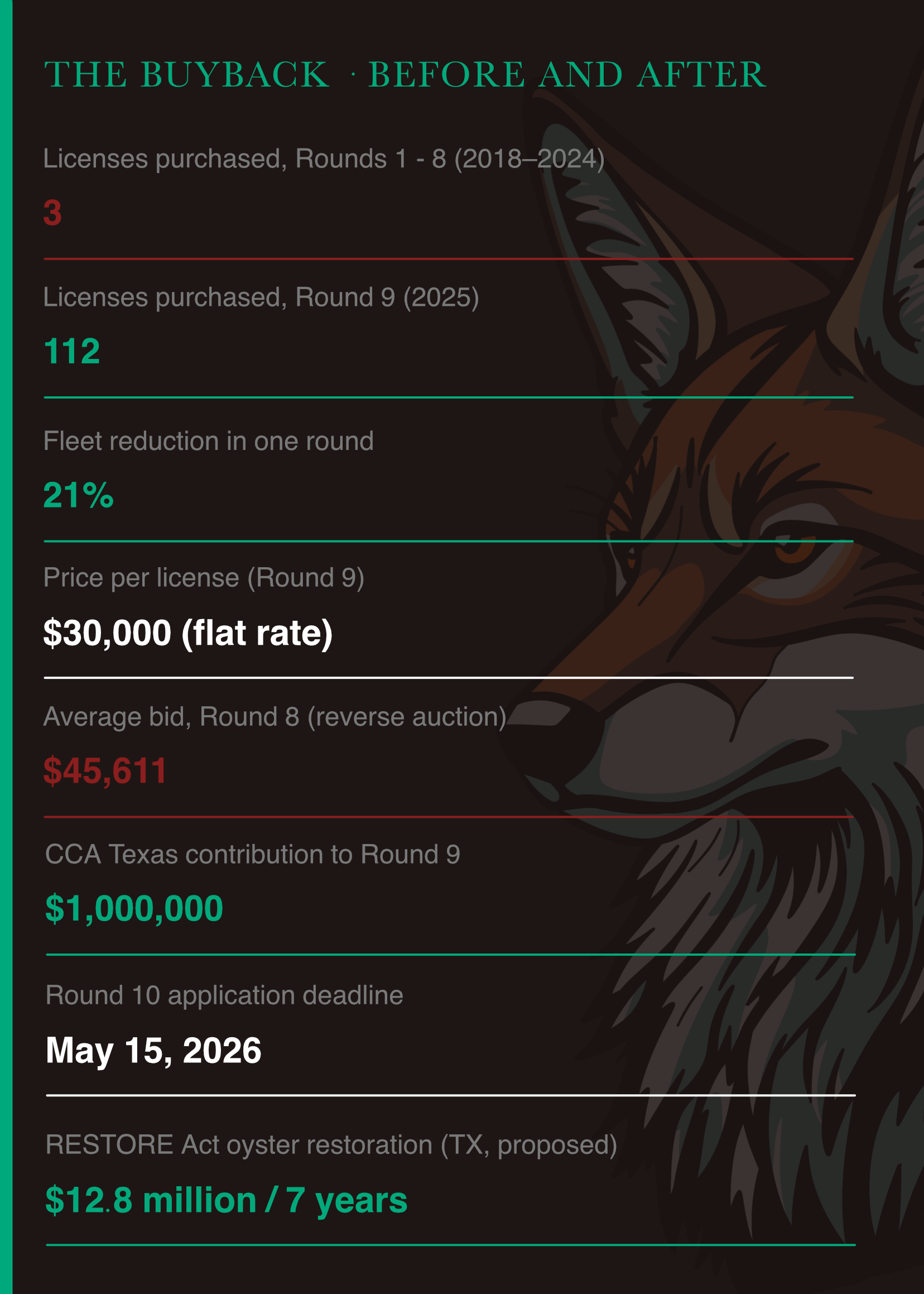
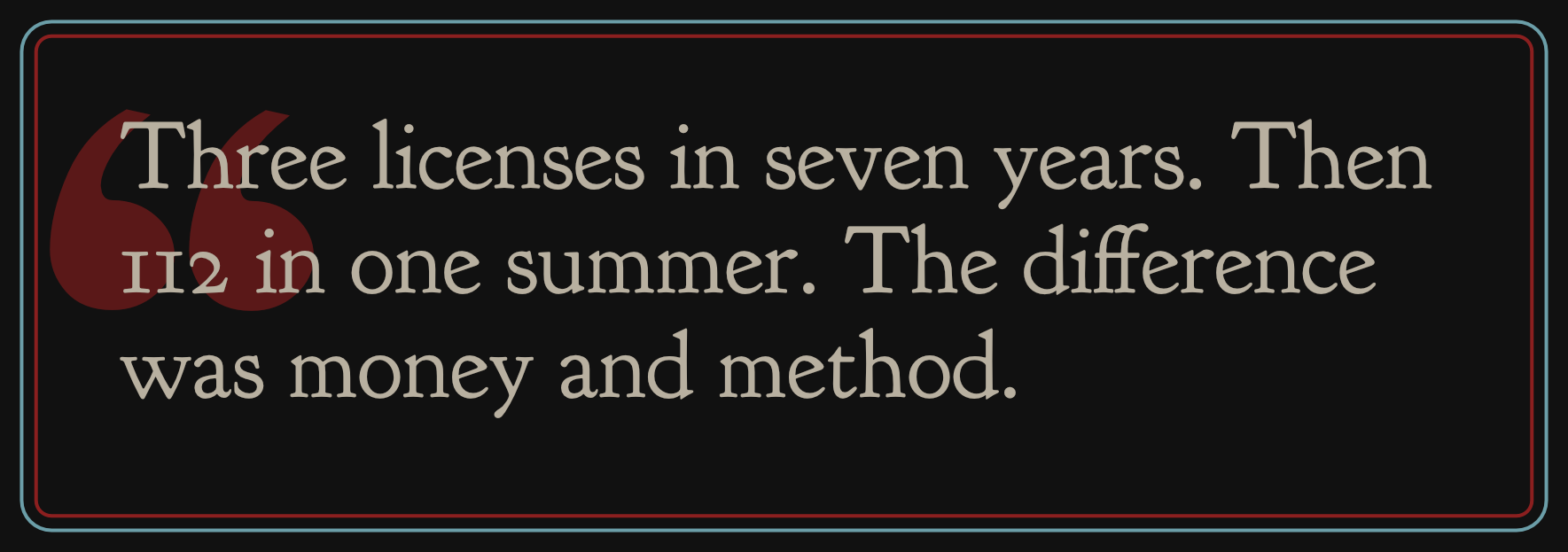
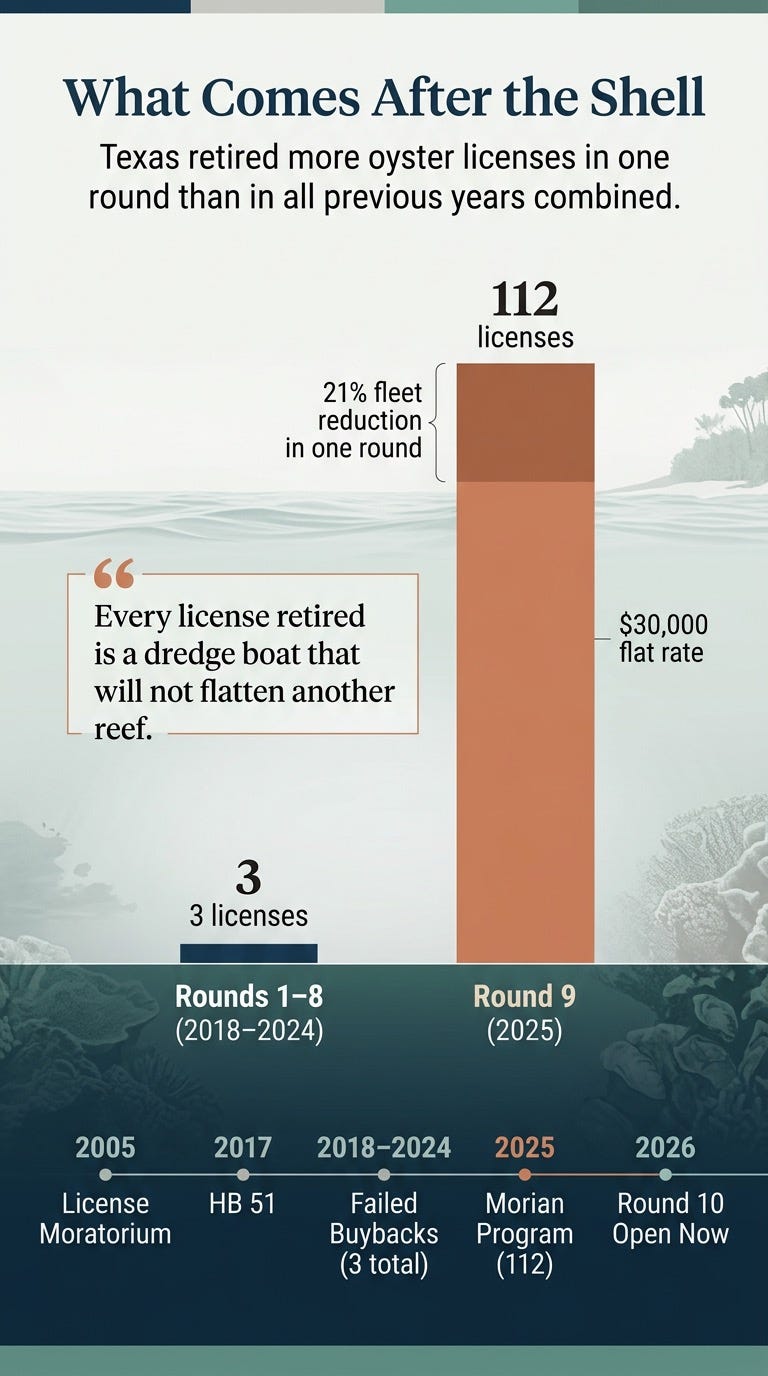
Something happened in 2025 that had not happened in the eight years since the Texas Legislature authorized commercial oyster license buybacks. The program worked. TPWD received 115 applications and purchased 112 commercial oyster boat licenses in a single round, reducing the total number of active licenses by 21 percent. In the previous eight rounds combined, from 2018 to 2024, the agency had purchased three. Three licenses in seven years. Then 112 in one summer.
The difference was money and method. The earlier rounds used a reverse-bid auction, where license holders named their price and TPWD selected the lowest bids. The bids were high. In Round 8 alone, the average ask was $45,611, the most common was $50,000, and the ceiling hit $100,000. The state could not afford to buy at those prices, and the program stalled. In 2025, TPWD and the Texas Parks and Wildlife Foundation partnered to create the S. Reed Morian Oyster Buyback Program, named for a former TPW Commission chairman. They offered a flat rate of $30,000 per license. CCA Texas contributed $1 million. The Laurie and S. Reed Morian Foundation, the Brown Foundation, the Earl C. Sams Foundation, and a coalition of private donors funded the rest. The price was fixed. The response was immediate.
Now a second round is open. Applications close May 15, 2026. TPWD is hosting workshops along the coast to walk license holders through the process. The funds are again coming from a public-private partnership, with donated money supplementing the department’s buyback fund. If this round succeeds at a comparable rate, the fleet will have been reduced by roughly 40 percent in two years.
This matters for reasons that go beyond the fishery. Every license retired is a dredge boat that will not flatten another reef. Every boat removed from the fleet is one less set of teeth dragging across the substrate that the next generation of larvae needs to settle on. The buyback does not rebuild reef. It stops some of the forces dismantling it. That distinction is important, because the bay needs both: fewer boats and more shell.
What Is Being Built
The restoration side is moving too. The RESTORE Council’s 2026 Funded Priorities List includes a $12.8 million Texas Oyster Reef Restoration Program, funded through the post-Deepwater Horizon settlement and focused on non-commercial reef habitat in state estuarine waters. The seven-year program will use substrate placement, living shoreline construction, and enhanced spawning reserves. Priority will go to projects that are ready to build and can scale.
Alongside the federal money, the existing restoration portfolio continues to grow. Half Moon Reef in Matagorda Bay, rebuilt by The Nature Conservancy with 100,000 tons of limestone, shows oysters on 70 percent of its surface. TNC’s Lap Reef and the 40-acre Beezley Reef in Galveston Bay use a hybrid sanctuary-harvest model. CCA Texas and Building Conservation Trust are restoring 27.7 acres of buried reef in the Sabine Lake system. TPWD has restored 1,720 acres across the coast. The Galveston Bay Foundation’s shell recycling program, Sink Your Shucks, and volunteer oyster gardening programs continue to return shell and monitor recruitment.
The January 2025 COL rule changes that allow new Certificates of Location to be issued specifically for reef restoration, rather than only for harvest, open a structural pathway that did not exist before. And the cultivated oyster mariculture program, still small, offers a model where oysters are produced without touching the wild reef at all.
What the Bay Loses Without the Reef
It is worth stating plainly what the bay looks like if the reef does not recover, because the consequences are not abstract and they are not limited to oysters.
Without functioning reef, the water stays turbid. The reef’s filtration capacity is enormous: a single adult oyster processes 50 gallons per day, and a healthy reef system can filter the volume of an entire bay in a matter of days. Without that filtration, suspended sediment blocks sunlight. Seagrass beds, which depend on light penetration, shrink. Juvenile redfish, spotted seatrout, blue crabs, and shrimp lose the nursery habitat that seagrass provides. The commercial and recreational fisheries that depend on those species decline. The guides, the bait camps, the marinas, and the coastal economy they support lose revenue.
Without reef structure, shoreline erosion accelerates. Oyster reefs function as natural breakwaters, attenuating wave energy before it reaches the marsh edge. A 2026 meta-analysis in Marine Environmental Research confirmed that restored oyster reefs significantly reduce wave energy in intertidal marshes. Without the reef, the marsh erodes. Without the marsh, the shoreline retreats. Without the shoreline, the property behind it floods more frequently and more deeply.
Without the soundscape, the cycle that this series began with in Part 1 does not restart. The snapping shrimp fall silent. The toadfish have no burrows. The drum have no structure to knock against. The larvae drift through quiet water and do not settle. The reef does not recruit. The silence deepens.
What the Bay Could Sound Like
The alternative is not fantasy. It is happening in discrete locations, measurably, right now.
Half Moon Reef sounds different than it did before restoration. The limestone substrate hosts shrimp, toadfish, and drum that generate the acoustic profile larvae need to find the reef. Oysters cover 70 percent of the surface. The reef is recruiting. It is building vertical structure. It is becoming, year by year, more like the habitat it replaced.
The buyback changes the math. If 112 licenses are retired in 2025 and another significant tranche follows in 2026, the fleet will be small enough that the remaining open harvest areas might actually sustain the pressure. The dredge boats that remain will fish reefs that are not being hammered by twice as many competitors. The reef between the dredge tracks will have time to grow. The shell return mandate, modest as it is, will start to close some of the gap between what is removed and what is replaced.
The $12.8 million RESTORE program, if it builds reef at scale in locations selected for ecological value rather than political convenience, will add acreage to the system that is permanently protected from harvest. Living shoreline projects that incorporate oyster reef as a wave-attenuation feature will connect restoration to property protection in ways that make the investment legible to coastal landowners and municipal governments.
The mariculture program will grow. More farmers will put cages in the water. The market will absorb half-shell oysters at premium prices that make the economics of dredge fishing look, over time, like the less attractive option. The regulatory distinction between mariculture (which produces oysters without destroying reef) and dredge fishing (which produces oysters by destroying reef) will become harder for policymakers to ignore.
None of this is guaranteed. All of it is contingent on sustained funding, sustained political will, and a climate that does not send a Category 4 hurricane through Galveston Bay before the restoration reefs have had time to establish. The reef is still in the ratchet. The question is whether the interventions now underway can turn the ratchet in the other direction before the next stressor hits.
The Honest Reckoning
I want to be careful here, because this series has not been built on optimism and I am not going to end it with a pivot to hope that the evidence does not support.
The buyback is the most significant structural reform in the history of the Texas oyster fishery. It is also a program that depends entirely on philanthropic funding and voluntary participation. The state has not committed the public dollars necessary to buy out the remaining fleet. The Legislature has not mandated individual quotas or effort controls. The regulatory architecture that Part 4 described, where the fishery manager and the habitat protector are the same agency, has not changed.
The restoration projects are real and some of them are working. They are also small relative to the scale of loss. Seventeen hundred acres restored against tens of thousands lost. The $12.8 million RESTORE program is meaningful. It is also a seven-year commitment in a system that has been degrading for a century.
The mariculture alternative is promising and structurally sound. It is also in its infancy, with a handful of permitted operations producing boutique product for a niche market. It has not yet demonstrated that it can absorb enough market demand to meaningfully reduce dredge fishing pressure.
What I can say, from the position of someone who works in wildlife rehabilitation on the Texas coast, is that the direction has changed. For the first time in the decades I have been paying attention, the policy conversation is about recovery rather than managed decline. The buyback is happening. The restoration is being funded. The mariculture framework exists. The COL program has been expanded to include restoration leases. These are not symbolic gestures. They are structural changes to the system that this series has spent four parts documenting.
Whether they are enough depends on time. The reef needs time to grow. The larvae need time to find it. The soundscape needs time to rebuild. The question is not whether the interventions are correct. It is whether they arrived soon enough, and at sufficient scale, to outpace the forces still working against recovery.
I do not know the answer. I do not think anyone does. But for the first time, the question is being asked with money behind it and boats coming out of the water. That is not optimism. That is the record.
This series was reported, written, and produced without grants, sponsorships, or institutional backing. WildTomorrow is funded entirely by paid subscribers. The organizations and agencies covered in these five parts would have preferred the full picture stayed underwater. That was never an option.
If this series changed what you know about the Texas coast, subscribe. The next investigation is already underway. See below for the prior articles in this series.


