

The Second Extinction
When a species disappears, it dies twice: once from the land, and once from the stories we tell about who we are. Conservation has no framework for the second death. Colonizers did.

There is a photograph that has become one of the most reproduced images in American environmental history. It was taken sometime in the mid-1870s, in Michigan or possibly Detroit, though the exact location has been disputed. In it, a man stands atop a mountain of bison skulls that stretches roughly ten feet above him and extends far enough in every direction to dwarf the frame. The bones were destined for fertilizer. They had been accumulating from the plains for years, from herds so vast that early explorers described them as darkening the ground like a moving storm. By the 1880s, somewhere between thirty and sixty million animals had been reduced to a few hundred. The mountain in the photograph is what remained of a world.
When that image surfaces in conservation writing, it is almost always framed as an ecological tragedy, sometimes as an economic cautionary tale, occasionally as the opening chapter of the American conservation movement. What it almost never gets framed as is what many of the people who witnessed it understood it to be: a cultural assassination. The bison did not disappear by accident, and the people who orchestrated the slaughter were explicit about what they were targeting. They were not destroying a food source. They were destroying a cosmology.
Interactive Timeline
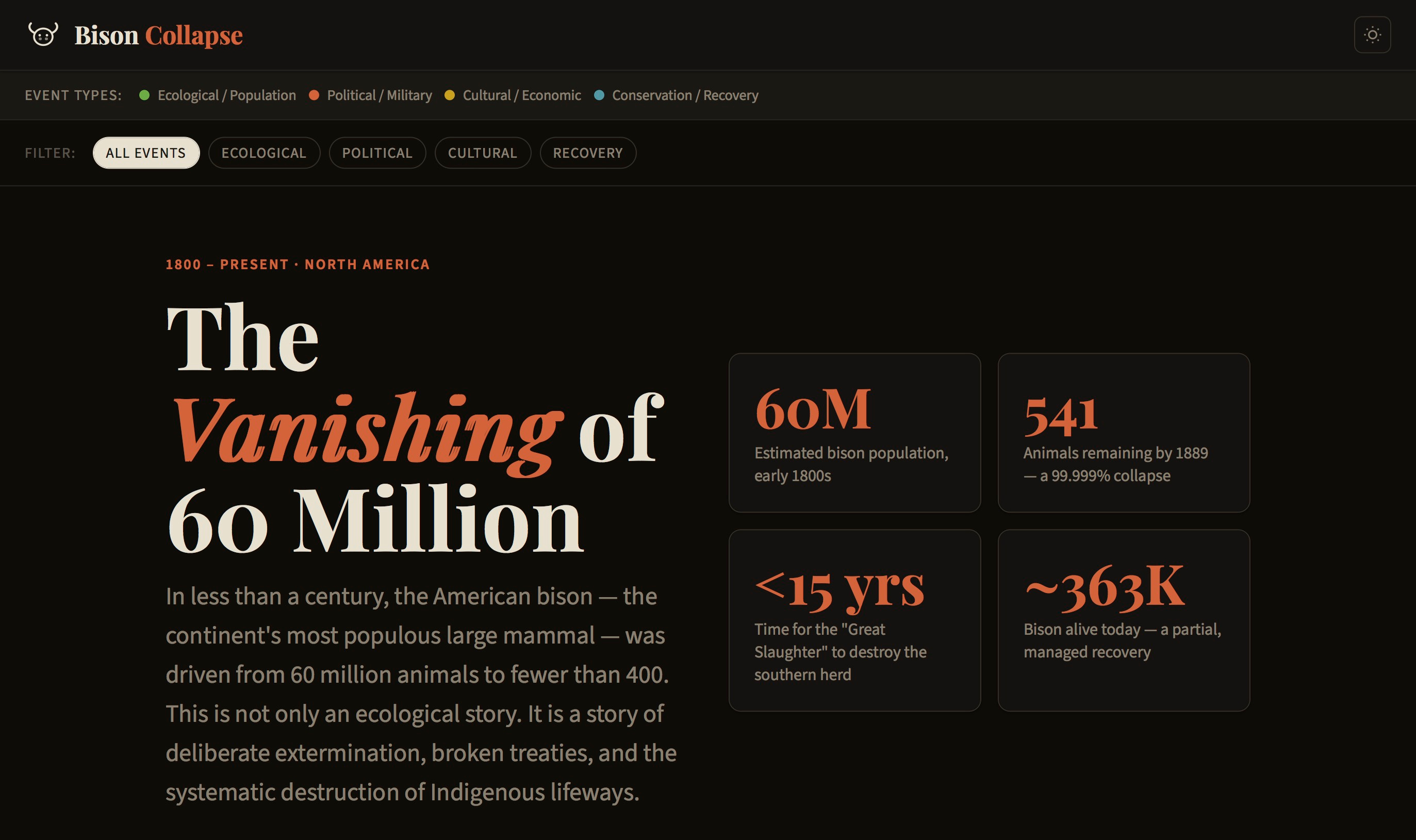
The Vanishing of 60 Million maps the bison population collapse against the political and military events that drove it — from the transcontinental railroad to Sheridan’s ammunition supply to the 541 animals Hornaday counted in 1889. Explore the full timeline →
Conservation science has built rigorous frameworks for measuring ecological loss. It has developed, more slowly, tools for estimating economic loss. But the question of what disappears culturally when a species goes extinct has been largely treated as too subjective to quantify, too diffuse to study, too soft to count. That framing is worth interrogating, because the people who have most deliberately used extinction as a weapon understood its cultural mechanics with extraordinary precision. If the destruction of wildlife can be wielded as cultural destruction, then cultural loss cannot be treated as a footnote. It has to be part of how we understand what extinction actually costs.
I. THE WEAPON THEY KNEW IT WAS
The near-extermination of the American bison in the second half of the nineteenth century was not a byproduct of westward expansion. It was an instrument of it. The distinction matters because it clarifies what was actually being destroyed and why.
The Plains nations did not merely depend on the bison economically. The bison was constitutive of their world in the most fundamental sense. It provided food, clothing, shelter, tools, and trade goods. It shaped ceremony, language, and cosmology. Among the Lakota, Cheyenne, Arapaho, Blackfeet, and dozens of other nations who had built their lives around the herds, the bison was not a resource. It was a relative. Tasha Hubbard, a Cree scholar, has argued that the slaughter constituted an act of genocide against the buffalo as a people within the epistemological frameworks of plains Indigenous nations, not merely as a population of animals. The distinction is not semantic. It speaks to the nature of the relationship that was being severed.
General William Tecumseh Sherman understood the strategic logic of that severance. In June 1869, the Army Navy Journal reported that Sherman had remarked in conversation that the fastest way to compel Plains Indians to submit was to send regiments to the plains with orders to kill buffalo until they became too scarce to support the tribes. General Philip Sheridan, Sherman’s subordinate, was more direct: “If I could learn that every Buffalo in the northern herd were killed I would be glad,” he wrote. “The destruction of this herd would do more to keep Indians quiet than anything else that could happen, except the death of all the Indians.” When the Texas legislature proposed a bill to protect the bison, Sheridan argued against it, telling lawmakers that the hide hunters were doing more in two years to settle the Indian question than the entire regular army had done in forty. He reportedly suggested giving each hunter a bronze medal with a dead buffalo on one side and a discouraged Indian on the other.
Richard Henry Pratt, founder of the Carlisle Indian School, was equally candid in hindsight. The destruction of the bison, he wrote after his retirement, was ordered as a military measure because it was plain that the Indians could not be controlled on their reservations as long as their greatest resource remained plentiful. This was not a fringe reading of events. The scholarly consensus, as historian Richard White has summarized it, holds that military commanders actively encouraged the slaughter of bison herds to cut the economic and spiritual heart from the Plains nations’ way of life. The bones in that Michigan photograph are not just the residue of industrial hunting. They are the material evidence of a deliberate attack on meaning.
Chief Plenty Coups of the Crow Nation described the aftermath in terms that capture something the ecological record cannot. When the buffalo went away, he said, the hearts of my people fell to the ground, and they could not lift them up again. Afterward, nothing happened. This is not a metaphor about food scarcity. It is a description of the collapse of a narrative framework for living. The buffalo had structured not just the subsistence economy but the ceremonies, the seasonal migrations, the spiritual obligations, the understanding of what it meant to be Crow. When it was gone, there was no longer a story to be inside. There was only reservation time and government rations and the grinding work of surviving a world that had been deliberately unmade.
II. THE SECOND DEATH
In 2022, researchers publishing in Trends in Ecology and Evolution formalized a concept they called “societal extinction”: the loss of societal attention and collective memory of a species, distinct from, and often following, its biological extinction. The paper’s authors, led by Ivan Jarić, described how extinction generates not one death but two. The first is biological. The second is cultural, a slow fading from the stories, the names, the ceremonies, the place names, the accumulated human knowledge that a species had generated over its time of coexistence with people. The second death, they argued, is cognitively intractable and tends to accelerate the first: as species disappear from cultural memory, public support for conservation and restoration erodes, targets become less ambitious, and the baseline of what a healthy ecosystem looks like quietly degrades.
The Japanese wolf offers one of the most precise case studies in what societal extinction looks like when it operates at full speed. The Honshū wolf, Canis lupus hodophilax, went officially extinct in 1905, killed by disease and habitat loss and persecution as agriculture expanded. It had been, for centuries before that, deeply woven into Japanese cultural life. Shrines were dedicated to it. Villages in mountain regions bore its name: Wolf Plateau, Wolf Marsh, Wolf Rock, Howling Wolf Pass. In Shinto tradition the wolf was a messenger of the gods, the mountain kami’s otsukai, a guardian of travelers, a protector of crops. Farmers made ritual offerings to she-wolves about to give birth. In the mountains of the Kii Peninsula alone, there were multiple dedicated shrines where wolf carvings served as guardian figures. Its name, ōkami, meaning great deity, encoded its spiritual status into the language.
More than a century after its official extinction, people in remote mountain villages were still reporting sightings. Researchers studying the phenomenon have noted that these reports are not straightforwardly delusional or wishful. They are, at least partly, a form of environmental symbolism, a way of insisting on the continued presence of something the landscape still seems to demand. The wolf’s cultural weight was so substantial that it has not finished dying even now. Shrines still stand. Talismans still carry wolf carvings. The species has been transformed into something more akin to a ghost than a memory, present and absent simultaneously, still doing the symbolic work of a living animal for a culture that has not yet found a replacement for what it meant.
This is what the researchers who coined “societal extinction” describe as cultural transformation: the process by which a species that was once a living, known, encountered presence becomes stylized, simplified, abstracted, and eventually mythological. The transformation is not neutral. As a species moves from lived experience into pure symbol, the accuracy and specificity of cultural memory degrades. The Spix’s macaw went extinct in the wild in 2000. A study of communities in its former range in northeastern Brazil found that children there now believe the bird lives in Rio de Janeiro, because of its starring role in an animated film. The bird persists in cultural memory, but what persists has been severed from any relationship to the actual animal, its habitat, its ecology, its precarity. What remains is a cartoon.
A study of the Hainan gibbon in China documented this process at close range. The Hainan gibbon is the world’s rarest primate, now restricted to a single reserve on Hainan Island after being extirpated across most of its range within living memory. Researchers found that communities in landscapes where gibbons had recently disappeared still retained rich folktales about them. In landscapes where the gibbons had been absent for decades, the folktales were largely gone. Older community members retained some knowledge. Younger ones had almost none. The folktales were dissolving at the leading edge of memory, following the animals into absence. Crucially, this trajectory was not linear: the practical knowledge of how to find, identify, and coexist with the animal tended to persist longer than the stories about what the animal meant. Utility survived longer than meaning. The culture kept the tool and lost the cosmology.
Madagascar offers a longer view of the same process. Folktales on the island describe a creature with the body of an animal and the face of a human, rendered helpless on smooth rock outcrops because it could not move on flat surfaces. Researchers have proposed that these stories preserve distorted cultural memory of the sloth lemur, Palaeopropithecus ingens, which has been extinct for several centuries. The animal is still there, in a sense, embedded in the narrative architecture of a culture that encountered it long enough for it to become meaningful. But what is there is not the animal. It is a ghost story, carrying just enough description to be traceable, distorted beyond recognition by the passage of time and the absence of the living referent. This is what remains when biological extinction eventually completes its work on cultural memory: not nothing, but something warped almost beyond recognition, a story about a creature no one has seen that no longer resembles the creature that generated it.
III. BASELINES AND THE EROSION OF THE SACRED
Daniel Pauly coined the term “shifting baseline syndrome” in 1995 to describe a pattern he had observed in fisheries science: each generation of researchers sets its baseline for what a healthy fish population looks like from the conditions that existed at the start of their careers. What was already depleted becomes the new normal. What was normal a generation ago becomes unimaginable abundance. The cod populations that collapsed in Atlantic Canada in the early 1990s had already been severely diminished for decades before the collapse; the “crisis” benchmarks were measured against baselines that were themselves impoverished. The problem was not just ecological. It was perceptual. People could not mourn, protect, or restore what they could not remember.
The same syndrome operates on the symbolic landscape. Each generation inherits not just a biologically depleted world but a culturally depleted one, and mistakes both for normal. The children in northeastern Brazil who believe the Spix’s macaw lives in Rio de Janeiro have not lost access to the real bird; the real bird is gone. What they have lost is the accurate memory of a loss, replaced by a cheerful fiction that asks nothing of them. The Plains nations who survived the bison slaughter did not get to forget. They carried the memory of a full world into a diminished one, and the distance between those two worlds was the measure of what had been taken. But their children carried a smaller distance, and their children’s children smaller still, until the inherited grief became historical rather than personal, and the bison became a symbol of resilience rather than a presence whose absence was actively felt.
This is not a process unique to colonized peoples, though colonization accelerates and weaponizes it. Researcher Selin Kesebir and Pelin Kesebir published a 2017 study in Perspectives on Psychological Science documenting a measurable decline over the twentieth century in references to natural species in English-language literature, song lyrics, and film. The natural world has been progressively disappearing from the stories that non-indigenous Western cultures tell about themselves, tracking closely with urbanization and the decline of daily contact with non-human animals. What does not appear in stories eventually stops mattering to the people who need stories to know what matters. The symbolic landscape depopulates along with the biological one, and people raised in the depleted version have no felt sense of the gap.
There is a particular loss embedded in this process that the conservation conversation has not adequately named. When a word for a specific animal disappears from a language, something in the relationship between a people and their land disappears with it. Research on biocultural diversity, the tendency for biological, cultural, and linguistic diversity to co-occur globally, has established that language death and species loss track together with striking regularity. The areas of the world with the highest concentration of endangered languages are substantially the same areas with the highest concentration of threatened species. The mechanisms run in both directions: ecosystem collapse accelerates language loss, and language loss accelerates the erosion of the ecological knowledge encoded in that language. A 2021 study in the Proceedings of the National Academy of Sciences found that language extinction triggers the loss of unique medicinal plant knowledge that exists in no other form. What is true of medicinal knowledge is true of ecological knowledge more broadly, and what is true of practical knowledge is true of the relational and symbolic knowledge that plants and animals carry in human cultures. When the last speaker of a language dies, every species name in that language dies with them. Every story. Every ceremony. Every accumulated observation about behavior and habitat and seasonal pattern that was held in that linguistic and cultural framework and nowhere else.

Interactive Map
Biocultural Overlap Explorer maps biodiversity hotspots against endangered language concentration zones and models the two-stage extinction sequence — ecological collapse first, cultural and linguistic erosion following. The overlap is not coincidental. Explore the map →
IV. THIS IS NOT ONLY AN INDIGENOUS STORY
The academic literature on biocultural diversity concentrates heavily on indigenous and traditional communities, and for good reason: the losses there are most acute, most documented, and most clearly tied to deliberate colonial disruption. But the framing creates a risk. When cultural loss from species extinction is positioned exclusively as an indigenous concern, it allows non-indigenous readers to receive it as a historical injustice or a distant tragedy rather than as an ongoing and universal process that operates differently across different communities but operates everywhere.
The Honshū wolf was not lost through colonization. It was lost through a combination of disease, habitat pressure, and the adoption of Western agricultural practices during the Meiji period, a modernization project that Japan undertook on its own terms. The cultural loss that followed was not inflicted by an occupying power. It was generated by the same mechanisms that produce cultural loss in predominantly non-indigenous contexts: urbanization, the shift away from landscape-dependent ways of living, the attenuation of direct human-animal relationships, and the substitution of symbolic abstractions for lived encounters. The shrines still stand in mountain villages on the Kii Peninsula. But the young people who pass them no longer know what lived in the mountains that the wolf’s name encoded. The landscape remembers. The culture is forgetting.
This is happening across Western contexts in slower and less legible ways. The replacement of traditional herbal medicine with synthetic pharmaceuticals across Europe has degraded general knowledge of medicinal plants to the point where species that were once intimately known are now essentially anonymous. The industrialization of food systems has severed the relationship between the animals people eat and any knowledge of those animals as creatures with behavior, habitat, and ecological role. The wildlife that persists in non-indigenous Western cultural consciousness is heavily filtered through charisma: the wolf, the eagle, the whale, the bear. The species that disappear unnoticed are the ones that were never charismatic enough to enter the symbolic economy in the first place, which means that their cultural loss is invisible even as it happens. People do not mourn what they never knew to name.
What is lost when non-indigenous Western cultures lose contact with non-human species is different from what is lost when an indigenous community loses the animal at the center of its cosmology. The depth of integration is different, the specificity is different, the directness of the relationship is different. But the process is related. Societal extinction researchers have noted that the loss of lived experience with a species produces collective forgetting across all types of communities, and that this forgetting diminishes conservation ambition, erodes restoration targets, and narrows the political will to protect what remains. This is not only a problem for the cultures doing the forgetting. It is a problem for the species that depend on human attention and care for their survival.
V. WHAT CONSERVATION KEEPS MISSING
The conservation conversation is organized around two primary value frameworks: ecological function and economic utility. Both frameworks have genuine power. Ecosystem services language has been politically effective in ways that purely ethical arguments have not. The economic valuation of biodiversity has succeeded in inserting conservation into policy discussions that would otherwise never have engaged with it. These are not trivial achievements.
But both frameworks share a limitation. They measure what can be monetized or modeled, and they struggle with what can only be inhabited. Cultural value, the meaning a species carries in the stories and ceremonies and place names and symbolic vocabularies of the people who live near it, does not fit cleanly into either framework. It is difficult to quantify, impossible to commodify, and tends to disappear from cost-benefit analyses that conservation policy depends on. The result is that extinction is consistently undercosted, because the cultural dimensions of the loss are systematically excluded from the accounting.
The people who deliberately weaponized extinction in the nineteenth century did not make this mistake. Sherman and Sheridan understood with precision that the bison carried something that could not be replaced by an equivalent food source, that the cultural and spiritual architecture of Plains nations was load-bearing on the living animal in ways that made the animal’s destruction the most efficient possible attack on the culture. They were not confused about what they were destroying. They were counting on everyone else to be.
A conservation movement that accounts only for ecological and economic loss is one that will continue to systematically undervalue what is being lost, and therefore consistently underinvest in preventing it. The bison on the Great Plains was not just an ecological keystone and a protein source. It was the axis around which an entire human world turned. The Honshū wolf was not just a predator filling an ecological role in mountain forest systems. It was a messenger of the gods, a guardian of crops, the thing that gave the mountain its meaning. The Hainan gibbon carries folktales in the memories of communities that have lived alongside it for generations, folktales that will not survive its disappearance, that exist nowhere else, that will not be recoverable from any database or archive because they were never written down and because the animals that generated them are nearly gone.
When an animal disappears from a landscape, it leaves behind empty niches in the ecosystem that took millions of years to fill. It also leaves behind empty niches in the stories a people tells about who they are and where they come from and what they owe to the world they live in. Conservation science has tools for mapping the first kind of emptiness. It has barely begun to develop tools for the second. That gap is not accidental. It reflects a value system that has decided, quietly and consistently, that ecological and economic losses are real and cultural losses are feelings. The people who used extinction as a weapon never made that mistake. Maybe it is time the people trying to prevent it stopped making it too.
Key Sources
Jarić et al., "Societal extinction of species," Trends in Ecology & Evolution, 2022
Gorenflo et al., "Co-occurrence of linguistic and biological diversity," PNAS, 2012
Cámara-Leret & Bascompte, "Language extinction triggers loss of unique medicinal knowledge," PNAS, 2021
Knight, J., "On the Extinction of the Japanese Wolf," Asian Folklore Studies, 1997
Smits, D., "The Frontier Army and the Destruction of the Buffalo," primary/scholarly source on Sherman/Sheridan policy
Hubbard, T., "Buffalo Genocide in Nineteenth Century North America," in Colonial Genocide in Indigenous North America, Duke UP, 2014
Wild Tomorrow runs on paid subscribers, not donor relationships with the organizations I cover.
If this piece mattered to you, consider sharing it with someone who needs to read it, or upgrading to a paid subscription to keep this work possible.