

The Pattern
The Record Series, Part 1 of 8. Two terms. Eight years of combined destruction. And a conservation record that is not a matter of opinion.

There is a version of this story where people want to believe both sides. Where they insist there must be something good in there somewhere, some environmental win buried under the headlines, some reasonable tradeoff being made by people who just see the world differently.
There is not.
What exists, across two presidential terms and eight years of combined environmental policy, is a documented, coordinated, sustained effort to dismantle the legal architecture that protects American wildlife, water, land, and air. Not a series of isolated decisions. Not a difference of opinion about regulatory burden. A pattern. And patterns, unlike talking points, leave a record.
This series is that record.
The Scale of What Has Happened
During Trump’s first term, from January 2017 through January 2021, researchers at UC Berkeley’s Center for Law, Energy and the Environment and Grist magazine documented 211 environmental rollbacks. These were not minor adjustments. They covered clean air standards, endangered species protections, public lands leasing, water quality rules, climate policy, and the internal capacity of the agencies charged with enforcing all of it.
The Washington Post’s independent analysis found that Trump weakened or eliminated more than 125 rules and policies specifically aimed at protecting air, water, and land, with 40 more rollbacks still underway when he left office in January 2021.
Courts pushed back hard. The Trump administration lost 83 percent of environmental litigation during the first term. Many rollbacks were struck down, stayed, or reversed under Biden. Several took years of legal work to undo. Some are still being litigated today.
Then Trump returned to office.
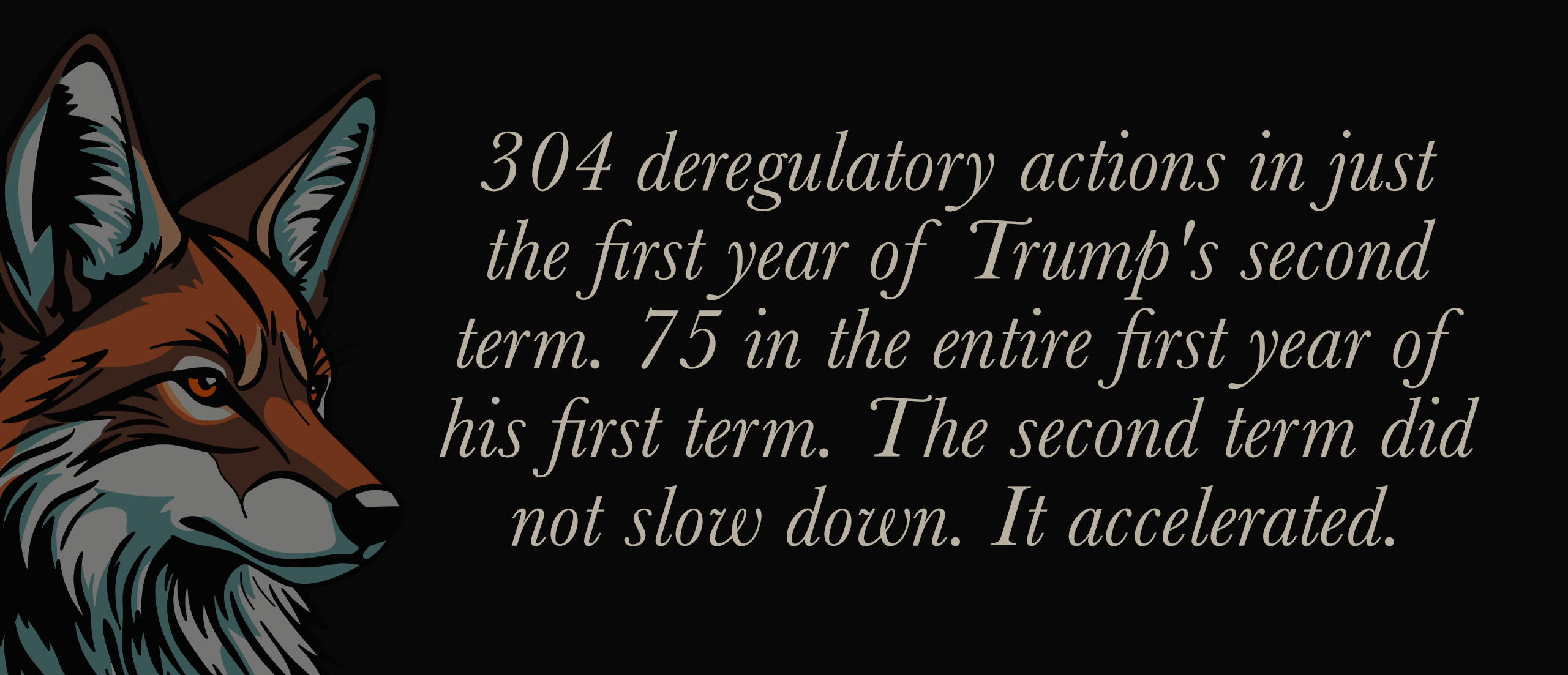
In just the first year of his second term, Columbia Law School’s Sabin Center for Climate Change Law recorded 304 deregulatory actions, compared to 75 in the entire first year of his first term. The Guardian independently counted 145 anti-environment actions in just the first 100 days of the second term, noting this exceeded the total number Trump completed across his entire first term. NRDC documented at least one destructive action or proposal per day through the first three months.
By the numbers: 211 rollbacks in Term 1. | 304 deregulatory actions in just year one of Term 2. | 145 anti-environment actions in the first 100 days of Term 2 alone.
This Is Not an Accident
The first Trump administration was characterized by what Brookings Institution researchers called a ‘simple playbook’: speed up the administrative process, suspend or overhaul environmental rules, and replace them before a successor could take office. Many of those replacement rules were deliberately designed to be difficult to reverse.
The second term came in better prepared. Over 40 percent of Project 2025’s recommendations have been achieved or are in progress, according to the Project 2025 Tracker. On environment and energy-related proposals specifically, 60 percent have been or are being implemented. Paul Dans, the former head of Project 2025, called Trump’s actions ‘beyond his wildest dreams’ in an NBC News interview.
This matters for a specific reason: it means the argument that these are good-faith policy disagreements does not hold. A good-faith policy disagreement does not require a 900-page blueprint written in advance by industry-aligned think tanks and implemented at a pace of more than one rollback per day.
What it looks like, instead, is what it is: a systematic effort to open public lands to extraction, weaken the laws that protect wildlife from extinction, strip the agencies that enforce those laws of staff and budget, and make the resulting damage as difficult as possible to undo.
What Happens When You Gut the Watchdogs
Rollbacks to rules and regulations get the most attention, but the damage to the agencies responsible for enforcing whatever protections remain on paper may be the most consequential long-term consequence of both terms combined.
In year one of the second term alone, 2,000 staff at the Environmental Protection Agency were lost. The Center for Biological Diversity described this as ‘crippling the agency’s ability to protect the public from poisonous pollution that sickens thousands of people every year.’ The proposed EPA budget for fiscal year 2026 would cut the agency by 52 percent, which NRDC called ‘sabotage.’ EPA administrator Lee Zeldin announced plans to shrink employment to levels not seen since the Reagan administration.
The U.S. Fish and Wildlife Service lost 18 percent of its staff between 2024 and May 2025, dropping from 9,957 to 8,179, per FOIA data obtained by the Center for Biological Diversity. These are the biologists, field agents, and listing specialists responsible for making the Endangered Species Act function. When they are gone, species that need to be listed do not get listed. Habitats that need to be designated do not get designated. The law stays on the books. Enforcement quietly collapses.
NOAA Fisheries’ Alaska Regional Office lost 24 percent of its staff in the first six months of 2025. The administration proposed a 28 percent budget cut to NOAA Fisheries, and internal documents obtained by CNN showed plans to transfer most fisheries functions to the Fish and Wildlife Service, an agency with no experience managing commercial fishing sectors. Multiple fishing seasons experienced delayed starts while waiting on the administration to approve required documents.
The National Park Service lost 24 percent of its permanent workforce under the second Trump term. Over 90 national parks reported operational problems between April and July 2025, affecting everything from sanitation to ranger staffing to visitor center operations.
What this means: Gutting agency staff does not just cut costs. It removes the human capacity to enforce laws that still technically exist. The damage is not visible in a headline. It accumulates quietly, species by species, case by case.
What Can Be Undone, and What Cannot
Courts did significant damage control during the first term. Environmental groups won 37 of 54 recent legal decisions during that period. After Biden took office, the administration reversed many, though not all, of the first-term rollbacks. Bears Ears and Grand Staircase-Escalante monuments were restored. Several ESA rule changes were vacated by federal courts. Some Clean Water Act protections were partially reinstated.
The second term has studied those outcomes and prepared accordingly. Legal experts at Inside Climate News note that while courts largely reined in first-term environmental rollbacks, such outcomes are less certain now. Appointments have reshaped the federal judiciary. Rules are being written more carefully to withstand administrative procedure challenges. And in some cases, like the loss of scientific staff, the damage is simply not reversible by court order. You cannot undo years of unreviewed permit applications or unlisted species through litigation.
The Center for Biological Diversity has filed more than 60 lawsuits against the second Trump administration. They have described some of the damage from the first year as ‘near irreversible.’ That word choice is deliberate.
What This Series Covers
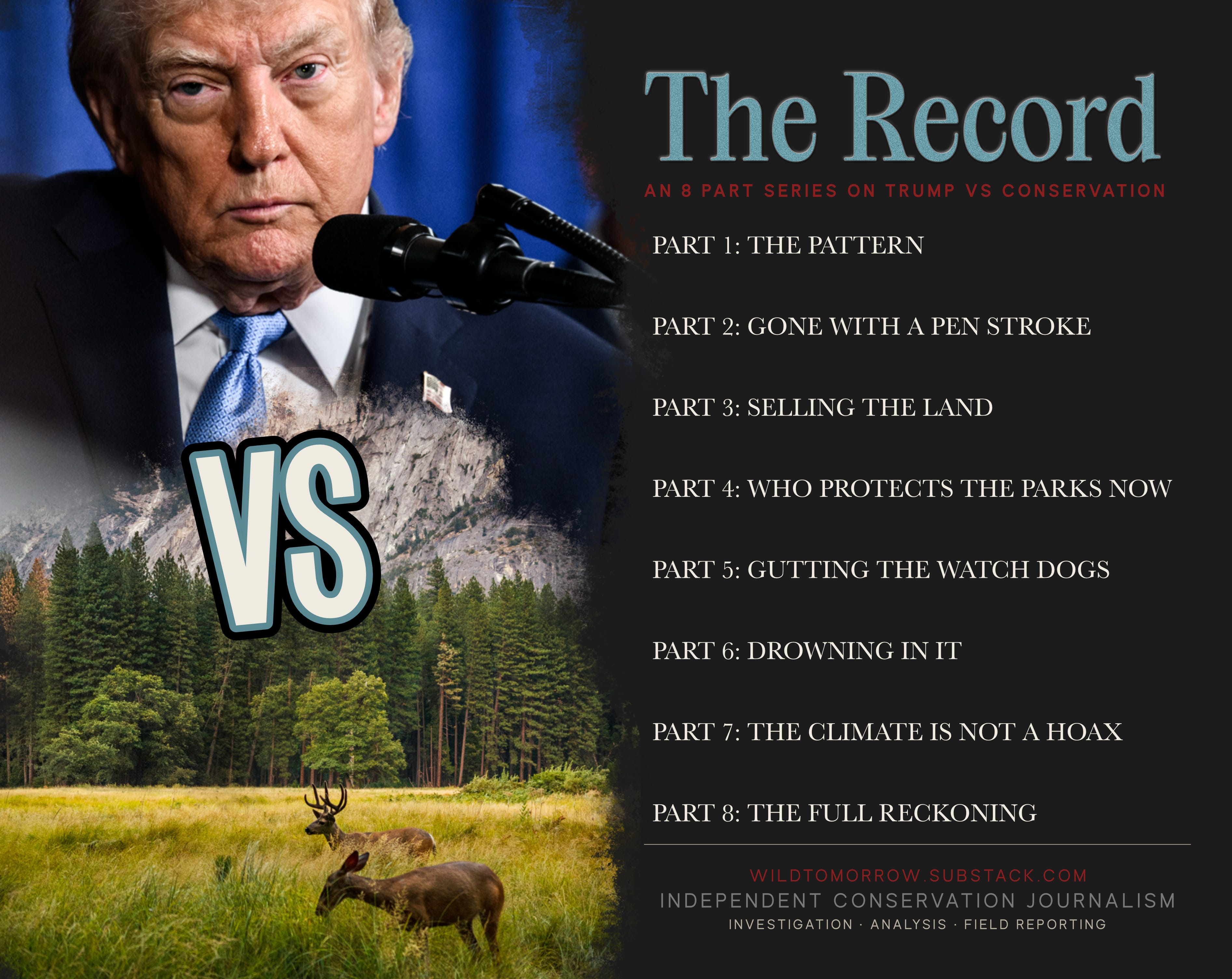
Over the next seven parts, WildTomorrow will document the specific categories of damage across both Trump terms in detail:
Part 4: National parks hunting rollbacks, including what changed at Lake Meredith in Texas and across 55 federal sites
Part 5: The gutting of FWS, NOAA, and EPA, and what the loss of scientific capacity means in practice
Part 6: Clean water, wetlands, and the WOTUS rollback threatening up to 91 percent of U.S. wetlands
Part 7: Climate rollbacks, the endangered finding repeal, and the fossil fuel subsidy machine
Part 8: The full reckoning, what was undone, what may never be recovered, and what you can do
This is not a partisan document. It is a factual one. The record exists. These parts of it belong together.
Ways readers can help:
Support organizations doing the legal work: Center for Biological Diversity, Earthjustice, NRDC, Defenders of Wildlife. Contact your U.S. Senators and Representatives, particularly on ESA appropriations and agency staffing. Document local impacts, species sightings, changes in water quality, land use near you, and report them to conservation organizations.
Sources: Grist / UC Berkeley Center for Law, Energy and the Environment, 2022 • Washington Post Environmental Rollbacks Database, October 2020 • Brookings Institution; Earthjustice • Columbia Law School Sabin Center Climate Backtracker, January 2026; The Guardian; NRDC White House Watch • Brookings Institution, 2022 • Sierra Club; NBC News; Project 2025 Tracker • Center for Biological Diversity, January 2026; Sierra Club; NRDC • Center for Biological Diversity FOIA data; Senator Whitehouse’s office, December 2025 • SeafoodSource; National Fisherman; Center for Biological Diversity • Earth.Org; New York Times • Washington Post; Earthjustice; NRDC • Inside Climate News, November 2025 • Center for Biological Diversity, January 2026